
Contents 9
You probably just scanned your badge from monso.si, the “Super-Human Resources” department, with its “AI lookalike” score. I launched that satirical site with AI agents, out of a joke. Its number is a game, but it doesn’t come out of nowhere: it’s based on two public measures, how exposed your job is to AI according to the International Labour Organization, and what AI is actually doing in that job already according to Anthropic1. Your answers to the quiz only move it by a few points, and that’s the joke. The question it asks is serious, though: will AI replace your job?
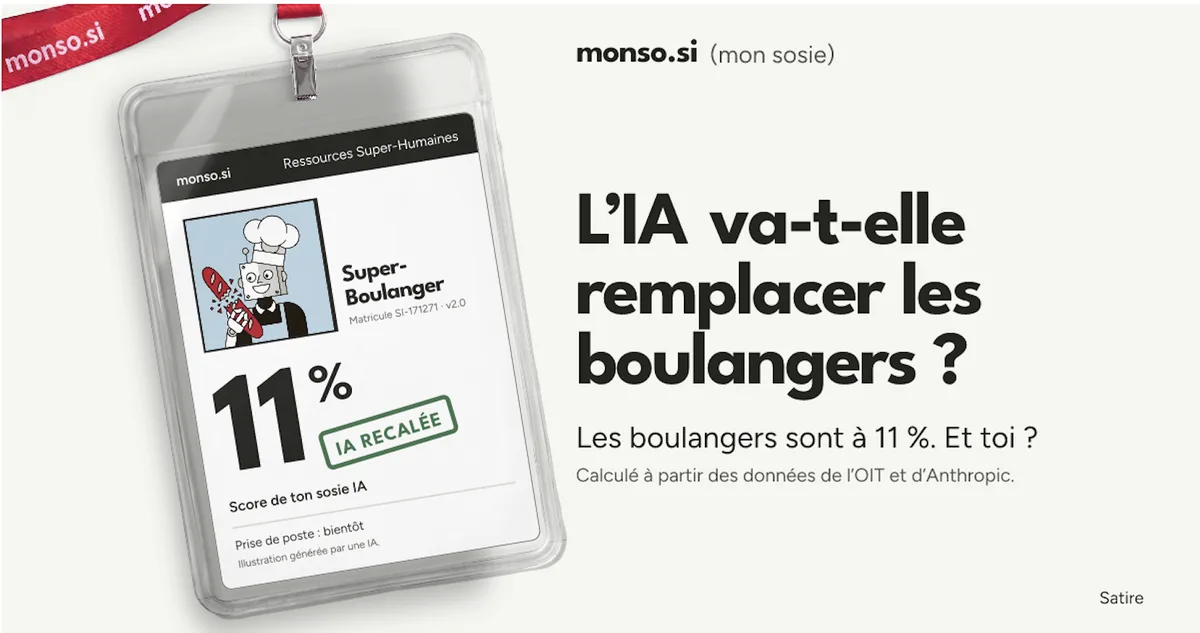
My conviction: AI won’t replace our jobs, it will shift them, in every sector. The machine will do the building in our place, even things that have never been done before, and what’s left for us is what we sign, meaning what we answer for: what we ask for, what we check, what we agree to publish or ship under our own name. I’ve been living this for almost two years, and measuring it for one. This post is an example: I didn’t type it, I asked for it, checked it and signed it (here’s how).
*I mean that condition seriously. This shift takes curiosity, a willingness to learn, and accepting that the way you work will change. Those who follow their work where it goes will gain a lot. Those who want to keep doing exactly what they did before risk watching a machine do the part they were holding on to.
Every machine has shifted work
The typewriter. Mass-produced from 1874, it replaced the copy clerks who transcribed documents by hand with typists, a job held mostly by women (BnF).
The ATM. In the United States, a bank branch employed about twenty tellers before ATMs, thirteen after. But branches, now cheaper to run, multiplied, and the total number of tellers went up. Their job changed: less counting cash, more advising customers (Knowable Magazine, after economist James Bessen). France saw the same shift, with fewer jobs: bank clerks fell from 356,000 in 1986 to 221,000 thirty years later (Le Figaro), and three out of four employees in the sector are now managers or professionals (AFB).
The spreadsheet. It appeared in the late 1970s, with the first personal computers, and replaced many bookkeeping clerks in the United States. Yet the number of accountants went up: they were asked to analyze and advise rather than add up columns (NPR).
Desktop publishing. In newspapers, typesetters composed pages in lead. Phototypesetting, then desktop publishing in the 1980s, made their trade disappear. That’s the other side of the same story: work shifts, but not always with the people who did it.
In 1865, economist William Stanley Jevons noticed that more efficient steam engines hadn’t lowered coal consumption in England: they made it explode, because more and more uses became profitable (Yale). When something becomes abundant and cheap, we produce far more of it, and value shifts to what stays scarce. The printing press multiplied books, and it was authors and publishers who mattered, no longer copyists. Code is becoming that coal.
AI does the same thing, but for almost everything that goes through a screen: it writes, it transcribes and reproduces voices, it creates images, sound and video, and it increasingly acts on its own inside our software2. That’s why it touches every office job at once, and why I think each of us is going to go through what I’m going through today.
The next wave has already started, while this one isn’t over: putting these same models into robots. On monso.si badges, a bricklayer starts at 5% today and a baker at 11%. For now. The day a robot learns a movement by watching someone do it, manual jobs, so far sheltered, will be exposed in turn. That day is getting closer: a robot has just learned tasks it had never seen from simple demonstration videos, and the State of AI Report says robotics is approaching its “GPT-2 moment”3.
I’ve been following AI since 2023
I didn’t get into it this year. I analyzed fifteen years of my activity on X (formerly Twitter): every tweet, retweet and like sorted by topic (the full analysis is here). In 2022, AI is less than 1% of the tech topics I follow. In 2023, the year after ChatGPT came out, it jumps to 10%. Then 37% in 2024, and 59% in 2025. My number one topic for ten years, the programming language I built my career on, falls to 3%.
What I read and share on X (formerly Twitter): the share of each tech topic, per year
- 0.2%
- 0.2%
- 1%
- 0.3%
- 9.8%
- 37%
- 59%
- 60%
* 2026: through September 29
For nearly three years, I mostly read and shared. I started writing about it in late 2025, once I had something to tell.
2026: the year everything sped up
I’m a CTO, a chief technology officer. My job is no longer writing code. It covers the company’s technical strategy, its medium- and long-term vision, the leadership team, budgets, trade-offs. Since Claude Code arrived in February 20254, agents have given me back something I’d lost along the way: building. I can once again show an idea with a working example rather than a slide deck, and unblock projects that were stuck or never a priority. These agents are AIs I hand a whole task to, which carry it out on their own and come back to me when they’re done or need me.
Since September 2025, a small tool I wrote keeps a journal of this work: the time I spend with them, what they produce, every contribution that lands in my projects. That journal has become my next project, Humanload: making agents’ work visible, counting the decisions and interruptions they generate, and trying to reduce that noise.
My agents' contributions, week after week, in 2026
record: 2,668 in one week
A contribution is a change saved in a project, the way you save a new version of a document. I wrote none of them. All of them come from agents, Claude Code or Codex, that I run. At the start of the year, they made about 90 a week, and still 120 in July. The pace picked up at the end of the summer, then everything took off: over the last four weeks, nearly 1,600 a week on average, thirteen times the July pace. This acceleration has two engines. First, the models: they are more powerful and work on their own for longer without needing me. The length of tasks an AI can complete on its own doubled roughly every seven months from 2019 to 2025 (METR). Second, working in parallel: I run several agents at the same time and move from one to the next.
What changed in 2026
- ×7.9work produced by my agents for every hour I spend with themJanuary–February vs the last four weeks
- ×17contributions by my agents per weekfrom 91 to 1,585
- 49projects I worked on in four weeks12 in January–February, over two months
- ×2.5time I spend with my agentsthe price of the acceleration
For every hour I spend with my agents, they now produce 7.9 times more work than in January. Over a week, my agents log 17 times more contributions5. Part of it comes from the extra time I give them (×2.5). The rest, a factor of roughly 7, is the machine.
A year earlier, over the same weeks of 2025, the gap is even sharper: per hour spent with them, my agents now produce 10.5 times as much as they did then6.
What the machine leaves me
If the machine writes for me, what’s left of my days? My journal answers fairly precisely.
My working day, on average
Decisionsan agent asks me to choose, approve or clarify, and I answer
Context switchesI move from one topic to another
Projects toucheddifferent code repositories in the day
Messages to my agentsfor scale
A working day now holds about 90 decisions7: an agent asks me to choose between two options, approve an action or give it a piece of information, and I answer. In January, it was about ten. The machine writes; I decide, nine times as often as at the start of the year.
The other change is the number of projects. In January, I moved from one project to another three or four times a day. Today, it’s more than 85 times, across eight projects on average, and up to 215 times on the busiest day. Several agents work in parallel, and I rotate between them. Picture an adult interrupted that often, by eight children taking turns, between meetings, emails and messages. At that pace, you end up losing track of what’s been done and what has moved forward.
In between, they carry on alone: for more than a third of the time an agent is working, I don’t write to it at all. I also correct them less: in one message out of four, down from more than one in three at the start of the year.
I ship more, and I take more risks
Deciding more doesn’t mean producing less. In January–February, I worked on 12 projects over two months. Over the last four weeks, on 498.
Above all, I can be wrong without it costing much. When a version takes a few minutes, I try three, keep the best, undo and redo. That’s how five satirical websites, monso.si among them, went live in less than a day, out of a simple joke. Before, an idea had to be worth weeks of work to exist. Now I just try it and see.
I don’t keep this way of working to myself. Part of my job as CTO is to bring my team toward it, without imposing my pace. I share what I try, what works and above all what fails, and everyone moves at their own speed. My numbers show what becomes possible; nobody is expected to match them.
AI is starting to make discoveries
In astronomy, an AI tool called RAVEN validated 118 new exoplanets in data from NASA’s TESS telescope, 31 of them never spotted before (Monthly Notices of the Royal Astronomical Society, March 2026).
In mathematics, a model beat an eighty-year-old record in May, on a problem Paul Erdős posed in 1946 (Scientific American). In early October, OpenAI claimed its agents had solved at least 372 open problems in a few weeks, in more than 700 papers written by AI (The Economist). Checking proofs like these takes weeks, even months (Science).
In AI itself, Claude led 26% of the measured research work on Anthropic’s models in August, against less than 1% in February, according to Anthropic’s own internal measure, cited by the State of AI Report 2026: AI is already helping build the next AI.
If you’re reading this a few days or a few months after it was published, this list is probably already out of date: I can no longer keep up with it.
The flip side of the acceleration
The risks are accelerating too.
Cyberattacks. In November 2025, Anthropic revealed the first cyber-espionage campaign largely run by AI agents: 80 to 90% of operations automated, around thirty targets (Anthropic). In France, on the night of October 11 to 12, 2026, hackers set the freezers of more than 300 supermarkets to more than 30°C (Le Monde). Nothing suggests AI was used that night, but the attack shows how far a computer intrusion already reaches into the physical world, and agents make it possible to run this kind of attack at a much larger scale.
Biological risks. Models that help biology researchers could also help people with bad intentions, and their safeguards aren’t foolproof: in September 2026, Anthropic reported that researchers had found ways around them, with no harmful intent according to the company (Congressional Research Service). RAND considers that no single safeguard is enough on its own (RAND).
Fatigue. And then there’s the risk I know best, because I’m living it.
These numbers don’t say I work less. AI has put everything within reach: a morning idea can be live by evening. On one condition: knowing the basics of the job. Agents move fast, they get things wrong just as fast, and you need to be able to recognize a mistake to catch it. Without those basics, you very quickly get something that looks like it works, until the day it gives way.
With the basics, it’s the opposite: everything becomes doable, so you do everything. I’m finally exploring all my ideas, personal and professional, and fixing one by one the problems we had swept under the rug because they were never a priority. My workload exploded, and nobody imposed it on me: not my employer, not a deadline. It’s passion that keeps me up, and that’s exactly what makes it hard to rein in. A Harvard Business Review study says it in its title: AI doesn’t reduce work, it intensifies it.
My evenings, week after week, in 2026
evenings when I sent more than 20 messages to my agents (0 to 7 a week)
The last two weeks: 6 then 7 evenings out of 7 after 8 pm, and 6 after 11 pm.
On evenings when I work after 11 pm, I send a median of 69 messages to my agents over the last four weeks, against 36 in January–February.
This fatigue has a name, “AI brain fry”: brain fog, slower decisions, headaches when you supervise too many agents at once. BCG measured it among 1,488 American employees. The French parody site Tokens Anonymes pokes fun at it, sources included, and sums up the signs and what helps (in French).
Tomorrow, in every job
What I’m going through with code, I think every job will go through with what it produces. In France, it has started: 18% of companies with 10 or more employees used AI in 2025, three times as many as in 2023, and 59% in the information and communication sector (Insee). Work is shifting in three directions.
From producing to asking. What matters is less how fast you produce than how clearly you ask. A vague brief used to cost a week of back-and-forth. Give the same brief to an AI and, ten minutes later, you get polished work that answers the wrong question.
From writing to checking. When producing costs almost nothing, checking becomes the work. A journalist who has an AI write a first draft has to check every fact and every quote in it. A developer has to try the software, not just reread the code.
From doing to deciding. Many people will end up working like an editor-in-chief: writing less themselves, commissioning, rereading and deciding what goes to print. To hold that role, everyone will need guardrails and checklists, so that a mistake caught once doesn’t happen again. Because we should never forget what an AI is: a probability machine. It computes the most likely continuation, and does it so well that the result often feels like magic. But likely doesn’t mean true. When it doesn’t know, it can make up a wrong answer with perfect confidence, what researchers call a “hallucination” (Nature, 2026). So checking stays human.
This shift won’t hit everyone the same way. Not every job holds the same share of decisions, and AI can already sort and judge. This post is proof: the decisions in my charts are detected by an AI that rereads and sorts my exchanges. But I set its criteria, and I sign this text. An AI can write, sort, judge; it can’t answer for what it produces. The journalist signs the article, the doctor the prescription, the developer the release: that’s the part that stays human.
Provided the job has that part. According to the International Labour Organization, one worker in four worldwide holds a job exposed to generative AI, but very few jobs can be fully automated; the most likely outcome is that they change (ILO, 2025). The most exposed are clerical jobs, and women’s employment is more exposed than men’s. And where AI replaces instead of assisting, beginners pay the price: in the United States, employment of 22- to 25-year-olds in the most exposed jobs is 19% below where it would otherwise be (Stanford, 2026). This worries me for those coming next. You need experience to know what to doubt, and those first jobs, the ones getting scarce, are exactly where people used to gain it. And critical thinking depends on trust: the more people trust AI, the less they check; the more they trust their own skills, the more they check (Microsoft and Carnegie Mellon, 2025). That’s why I put an asterisk in the title.
Why this excites me
I’ve always had a bias for action: ship, move the product forward, fix fast what breaks. For fifteen years, the brake was the time it took to write everything. Generative AI, through agents, lifted it. What’s left (understanding the need, experimenting, choosing, checking) is the part of the work I’ve always liked best.
That doesn’t make me a role model; I’m more of a load test: I push the system to see what needs adapting and where it gives, and I publish what I measure. I go into the cost of that speed in The apple tree and the basket.
I hope as many people as possible get to feel this excitement. Nothing guarantees it: according to the International Labour Organization, how jobs change will mostly depend on the choices made now, by governments, employers and workers’ representatives (ILO). AI can widen the circle of people who create, or deepen the gap between those who know how to use it and everyone else.
Which leaves the satirical badge from the start. Mine gives me a 38% “AI lookalike” score, a way of measuring how exposed my job is to AI. It isn’t a prediction, but I know that number will go up. One day, my badge may say 98% exposure. I’ll be there to show that even the remaining 2%, the part we sign, makes all the difference. AI does the work; we sign it.
Tristan Bessoussachief technology officer (CTO), October 20, 2026
Footnotes
-
On monso.si, each job’s starting rate is the average of two indices scaled from 5 to 95%: the ILO generative AI exposure index (2025) and Anthropic’s “observed exposure” (2026), meaning what Claude already actually does in that job. Each of the three answers adds or removes at most 4 points. For a CTO, the starting rate is 40%; my answers gave me 38%. It’s an index built for the game, not a probability of replacement. ↩
-
According to the Stanford AI Index 2026, AI is progressing on text, code, speech, images, video and agents. In France, companies that use speech recognition employ 41% of employees, those that generate images, video or sound 42% (Insee). ↩
-
Skild’s S1 robot performed unfamiliar tasks from demonstration videos, without retraining (State of AI Report 2026). GPT-2 came out in 2019, nearly four years before ChatGPT. The bricklayer and baker rates are monso.si’s starting rates, before the answers. ↩
-
Claude Code, Anthropic’s coding agent, came out in preview on February 24, 2025 and for everyone on May 22, 2025. ↩
-
A contribution is a commit, a saved change of code in a repository. My journal only sees the repositories present on my machines, and several only appeared there in October: the ×17 is therefore a little inflated. The ×7.9 per hour doesn’t depend on that bias. ↩
-
For that 2025 period, my journal only has conversations for 14 days out of 28. So I only take a per-hour ratio from it, not volumes. ↩
-
A decision is an answer from me to an agent that asked me to choose, approve or provide information. They are detected by an AI model that rereads my exchanges, not yet calibrated, or by a click on a multiple-choice question from the agent. Averages cover the days I wrote at least one message. ↩
-
A project is a distinct code repository, counted as soon as I worked on it, whether it shipped or not. A renamed or moved repository counts once, and working folders without a repository don’t count. ↩