Contents 6
On September 29, the White House signed an executive order requiring federal agencies to say “Super Intelligence” instead of “AI”. Two days later, I had six .si domain names (Slovenia’s extension) and one idea: ride the joke while it was still fresh.
A topical joke lives a few days. Two years ago, by the time six sites were coded, it would have been dead. On Thursday, October 1, between 16:00 and 18:00, my agents put the MVPs of five sites into production, and almost the sixth.
This post isn’t about typing speed. It’s about what becomes possible when building costs almost nothing, and about the part of the loop that didn’t get any shorter.
The afternoon, minute by minute
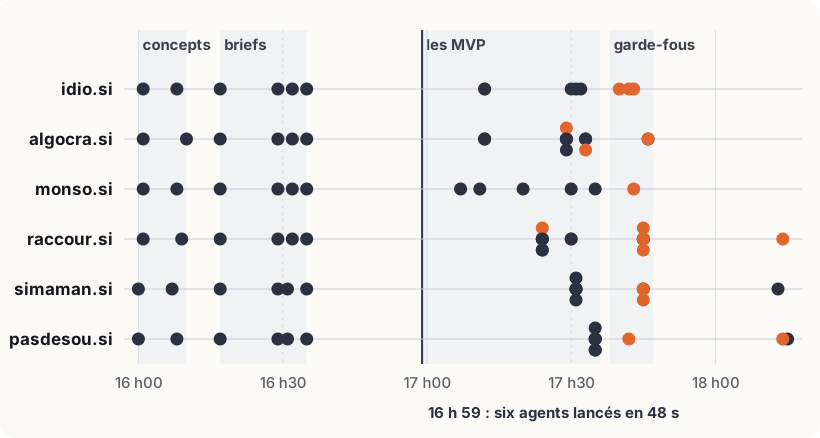
Thursday, October 1, from 16:00 to 18:00: one lane per site, one dot per commit. In orange: guardrails and fixes requested in review. Paris time (24-hour clock), taken from the git history.
| Time | What happens |
|---|---|
| 16:00 | An agent creates the six repositories, in one minute. |
| 16:07 to 16:10 | Six market studies in parallel. Each one recommends a concept. |
| 16:17 | I keep the six concepts; an agent writes six briefs and the agents’ working rules. |
| 16:29 to 16:35 | The only hiccup: I try Cloudflare’s new CLI, which can’t build an Astro project yet. Back to Wrangler. |
| 16:59 | I launch six Claude Code sessions, one per site, within 48 seconds. |
| 17:07 to 17:35 | The six MVPs: Astro, Workers, D1, KV, R2, generated share images, pages. |
| 17:38 to 17:46 | Cost guardrails and the fixes requested in review. |
The next day, the agents connected the real domains and reworked the interfaces. By October 2, five sites were online. Over the first five days of October, my agent journal counts 191 commits on these repositories, 190 of them co-written by an agent, 69 sessions and about 3,000 tool calls. I didn’t have to interrupt an agent once.
The cost: at public API prices, the afternoon’s six coding sessions come to about $120 of tokens. The first five days of October, polishing included, about $350.
Six jokes, six products
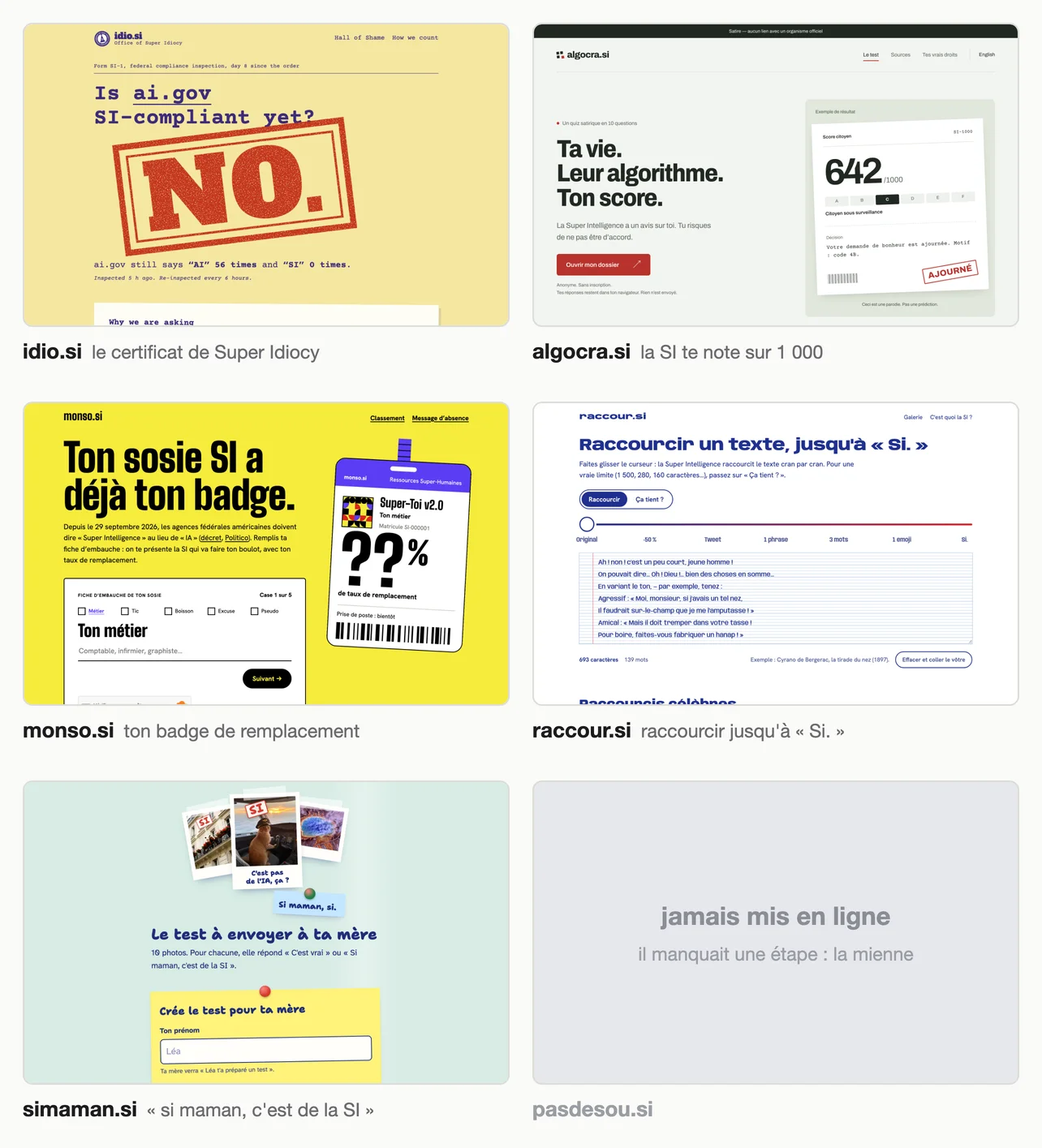
- idio.si reads a site’s home page, counts its “AI”s and its “SI”s, and issues a Super Idiocy certificate. On October 1, ai.gov showed 67 “AI” and 0 “SI”.
- algocra.si: a quiz where “the Super Intelligence grades you” out of 1,000, then admits which criteria were made up.
- monso.si generates your HR badge for being replaced by an AI, with your “replacement rate”.
- raccour.si shortens a text, step by step, down to “Si.” (the name is a pun on raccourci, French for “shortened”).
- simaman.si: ten photos to send to your mother, who must answer “that’s real” or “yes mum, that’s SI”. The test ends with a family password against voice-cloning scams.
- pasdesou.si: PDS-1, the Super Intelligence that answers “no worries” to everything and never does anything. It never went online; more on that below.
From idea to production, not to prototype
Nobody is surprised anymore when an AI writes a website in half an hour. What interests me is the gap between a prototype and a service you can leave running without thinking about it. Take idio.si: it fetches any URL a stranger on the Internet gives it. That’s exactly the kind of service that ends in a nasty bill, or in a door into its host’s internal network.
Half of the guardrails were in the brief, before the first line of code:
http(s)only, 8 seconds and 2 MB at most, a User-Agent that says who it is;- no private address and no
localhost: that’s the defense against server-side request forgery (SSRF); - respect for
robots.txt, and a six-hour cache per domain; - verdicts written to defame no one. A company still at 100% “AI” gets congratulated (“Still Artificially Intelligent ✓”). Only federal agencies, which the order actually targets, can be declared “Insubordinate”.
The other half came in review, between 17:40 and 17:43, when other agents reviewed the code:
- no share image generated for a domain that was never inspected (otherwise every made-up URL costs a render);
- logs sampled at 25%;
- a lock per domain in D1, so the same URL isn’t inspected ten times at once;
- a quota per /64 IPv6 block rather than per address: a single machine owns billions of them;
- the scheduled task runs in the United States, where the inspected sites are.
The other sites got the same treatment: an AI gateway with a $2-per-day spending cap and no conversation logs, message moderation, an encrypted cache, signed share links that never store the original text.
That, I believe, is the gap between what a non-technical person gets from an agent today and what I got. Two years ago, the question was: “can I code it?”. It has become: “do I know what to ask for?”. My job wasn’t used to write the code. It was used to write the brief, and to have other agents review the code.
What becomes worth building
In November 2024, I wrote here about my first app built with an AI. In under an hour, I had done what would have taken me 4 hours. But it was “like working with a brilliant but distracted child”: I had to keep steering it back. Two years later, I no longer write the code: I write briefs, and I launch six sessions within 48 seconds.
Productivity studies measure something else: how much time you save on the same task. In 2025, METR found that experienced developers took 19% longer with AI. In February 2026, the organization announced it was revising its protocol: 30 to 50% of developers were choosing not to submit some tasks to it, because they didn’t want to do them without AI. One of them explains it: he avoids submitting tasks that AI finishes in 2 hours and that would take him 20.
That’s where the real change is: in the tasks people start taking on. Six satirical sites for a joke that lives a few days, nobody would have coded them: by the time they shipped, the joke would have been dead. At under two hours and about $120, they become a reasonable bet. You can test an idea on the real market the same day, instead of debating it for a sprint.
The loop still has to close, though.
The loop stops where the code stops
Building is only half of the loop. The other half is putting the product in front of people and learning from how they react. That half didn’t get shorter by itself.
Five of the six repositories contain a complete launch kit: post copy, times, images, threads for X, Reddit and Hacker News. The agents wrote it on day one, before 17:46. I used only a piece of it: one X thread for idio.si, on October 3. Its first post got 131 impressions. The other launches are still waiting for a decision: reviewing a legal notice, picking a time, pressing “Post”. Without a launch, the sites’ counters only measure that absence: as of October 7, fewer than twenty visitor actions across five sites, my own tests included.
The only time the loop closed, it happened by chance, on the evening of October 6, at a restaurant. My best friend wanted to see simaman.si, which I didn’t even think was online. He sent it to his mother, who took the test and replied: “I’m so good at this”. I hadn’t tested anything myself. The site was designed to travel exactly like that, from a child to their mother on WhatsApp.
Five days between the idea and a real user’s reaction, without any promotion. The loop can now fit in a few days. But it doesn’t close without someone sending the link. As for pasdesou.si, it was missing a single step: creating the AI gateway that caps spending. That one was mine.
The bottleneck moved again
In the year I’ve been measuring my work with agents, I’ve watched my bottleneck slide from production to decisions. These six sites are the clearest demonstration of it. That Thursday afternoon is also the peak of my scattering this fall: in early October, I switched projects every two minutes.
What still costs is everything that isn’t code: deciding to launch, owning the act of showing something funny in public, coming back to answer people, choosing which of the six deserves my time. And a topical joke has an expiry date: the window is counted in days, not weeks.
What I’m changing:
- The launch becomes part of the definition of “done”, just like the guardrails: a project isn’t shipped until its first post is published and I’ve answered the first comments.
- One bet at a time when it has to be distributed. Six sites in parallel means six launches to do, and I did one.
- Distribution goes through other people’s conversations. On X, my replies under bigger accounts’ posts bring me far more reach than my own posts. A topical joke has to go where the news is being discussed.
My agents gave me six products in one afternoon. I still have to learn how to launch them.